Prism tracker
A compact collector can steer with a rotating prism over a fixed semi-parabolic trough. Smaller ground pitch than a full trough or a flat plate.
SP-0 / SP-1
DWG SP-0 / SP-1 · Rev A · 24 Sep 2026
Crown CPV+Split
A vertical photovoltaic face that yaws with the sun, and a high-flux crown that breaks the beam into bands. The article you can build today is neither of those shafts. It is a 1.5 m dish, a CPC, a prism, and cells on a cold plate.
Phase 0 · Lab or rooftop
1,500 mm dish, CPC secondary, fused-silica prism, band-matched cells on a cold plate, IR dump. The sheet calls the design focus about 1.2 kW thermal at DNI 900 and η 0.75, from 1.77 m² of aperture. The bench below multiplies those three numbers directly. Do not open the full aperture until coolant is proven.
Coolant
Wait
Envelope
Wait
Aperture
Wait
Design point is 900.
First article 80–200×. Hard envelope 50–500×.
Assumed split into the dump. Not a measured spectrum.
Coolant not proven. Flow before sun.
Instrument view. Geometry is schematic, not a ray trace.
Power is DNI × 1.77 m² × 0.75. Delivered flux is geometric concentration times the same 0.75, so optical loss cuts intensity as well as watts. Bed rise assumes a 20 L mineral-pebble charge, about 30 kg at 0.8 kJ/kg·K, taking only the IR share. The bench does not measure cell temperature. Hold under 80 °C. Trip at 85 °C. Bed design is 400 °C; 600 °C only after the materials qualify.
Path
Dish, then CPC, then prism. A prism alone, with no concentration, is the weak case in the inset.
Dish CPV
Reference receiver heads: multi-junction cells, a Stirling engine, or a thermal absorber. Phase 0 uses the cells, and dumps the IR.
Sun → dish → CPC → prism → multi-junction → load. The orange drop after the prism is residual IR into the dump, then the 20 L bed, then the optional column.
Architecture · not Phase 0
The tower drawings put a high-flux ring on the shaft: primary mirrors, a CPC funnel ring, one prism, rainbow cell bands, and a cooling loop. That stack is the same path as the switchyard, built as a crown instead of a single tracked dish. It is not sized, and it is not in the first article.
Optical explode
High-flux solar input into the CPC throats. The prism disperses onto the cell bands.
A segmented ring focuses direct sun downward into the throats of the CPC secondaries.
Crown section
Section through the concept stack, crown to pebble beds. Scale bar on the sheet is 20 m — a machine, not the 2 km shaft.
A compact collector can steer with a rotating prism over a fixed semi-parabolic trough. Smaller ground pitch than a full trough or a flat plate.
The long classic. The sheet shows it taking more length on the ground for the same idea of a line focus.
No concentration. This is the cousin of the vertical PV skin: it works on diffuse light, and it does not feed a prism.
Collector comparison
Reference layouts. The Sprocket crown is a ring of dishes, not this trough. The prism is the shared idea.
One face · one bearing
Morning east, noon south, evening west. The vertical array lives on one face, so the tower turns on a yaw bearing instead of tiling every azimuth. The crown rides the same structure. This study is not the Phase 0 article — Phase 0 has no shaft and no bearing.
Shaft facing south
12:00
Top view. Brass edge is the photovoltaic face; it points at the sun’s azimuth. Elevation is a sine from sunrise to sunset, peaking near 68°. On a vertical face that already tracks azimuth, the beam factor is the sine of elevation. Diffuse still reaches the skin when that factor is low. Not a yield model.
Morning · noon · evening
Same structure, three yaw angles. The sheet calls it a 2,000 m tower. Scale is consistent across the three panels and is not a measured height.
Yaw ring study
Steel hub, brass races, carbon hoop, stub shaft. A study of the bearing, not a duty cycle.
Coil triad
Three-coil assembly in a split housing. Not assigned a Phase 0 duty.
Band-matched cells
The crown paints bands sideways with a prism, one color to one cell. The coupon sheet peels a narrow infrared slice onto silicon and sends the rest through a monolithic triple junction. Same intent: stop asking one bandgap to waste the rest of the spectrum.
Filter and triple junction
Colours on the sheet are indicative. Energies are the labels that matter.
| Junction | Gap | Role |
|---|---|---|
| Si | 1.10 eV | Side cell, via the band-reflect filter |
| Filter | 1.18–1.38 eV | 900–1050 nm peeled off the stack |
| GaInP | 1.88 eV | Top junction of the monolithic triple |
| GaInAs | 1.41 eV | Middle junction |
| Ge | 0.67 eV | Bottom junction |
Phase 1 · still closed
Residual infrared after the prism is the first thermal stream. It lands in a 20 L packed bed, design 400 °C. A catalytic column that turns heat and intermediates into fuel is drawn, and it stays shut. No process gas until the bed is isothermal and the relief is set.
Bench scale
Cold plate and a bead column. This is the size of the work.
Media
Low-cost pebble media. Mixed sizes, packed, not a structured catalyst yet.
Surface
The reaction the later column is for. Not licensed by a pretty picture.
If it qualifies
R-301 and its neighbors are the picture after materials qualify. Not the 20 L vessel.
Smoothing machine
A heat engine on the thermal stream would smooth output the way the flywheel smooths yaw. Study only.
Ground, as drawn
The land sheet puts a conventional spread at 1,500–2,000 acres beside a single circular podium of about 741 acres. The podium is the flared base under the yawing shaft, with stalls drawn as an EV garage. It is out of scope for Phase 0, same as the shaft and the utility tie-in.
Acreage sheet
Graphic comparison. The 741 acre figure is the label on the sheet, not a survey.
1,500–2,000 acres
~741 acres
Where the watts would go
PV wall and crown meet at the inverters. 250–350 MW is the class written on that sheet. The switchyard on this page calculates about a kilowatt.
Build sequence
Phase 0 · Open
Lab or rooftop. Dish, CPC, prism, coupons, cold plate, IR dump. This is the open work.
Phase 1 · Next
20 L bed at 400 °C design. 600 °C only after materials qualify. Gas stays off until the bed is isothermal and the relief is set.
Phase 2 · Later
One vertical PV coupon, and a bearing that can actually turn a mass. Not a two-kilometer shaft.
Phase 3 · Shut
Switchyard signed off. Only then does a shaft, a podium, or a utility tie-in become a drawing someone can build.
Out of scope until Phase 3: the 2 km shaft, the podium, and a utility tie-in. Drawing note is in millimeters. It is not a drawing for a two-kilometer tower.
Drawing index
Select a sheet to read it large. Captions say what the drawing is, and what it is not.
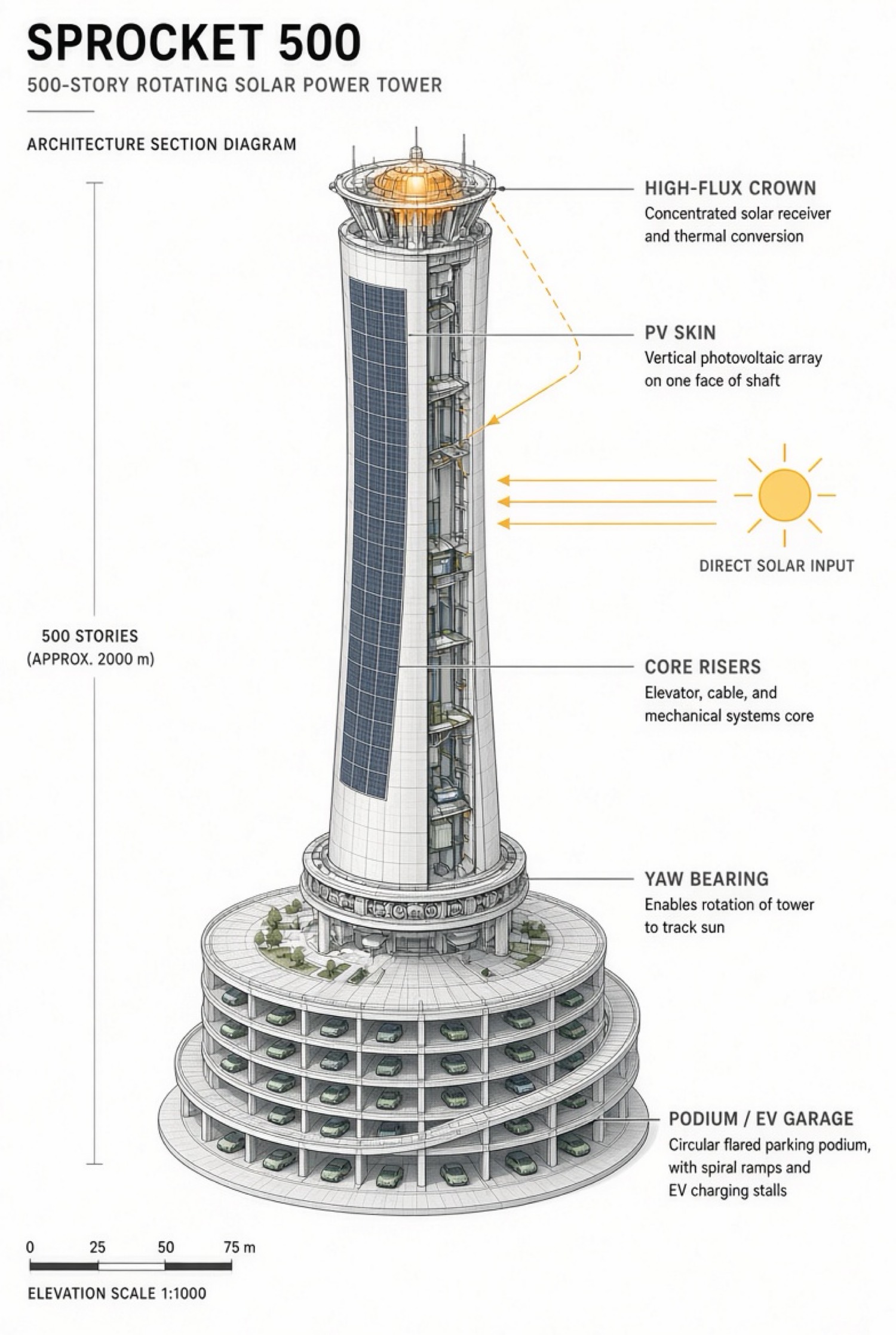
SPROCKET 500
Elevation study. Crown, PV skin, core risers, yaw bearing, podium and EV garage.
Crown section
Machine-scale section, 20 m bar. Crown through pebble catalysis.
Optical explode
Primary, CPC, prism, cell bands, cooling loop.
Yaw day
East, south, west. One face.
Prism path
Why the concentrator is in front of the prism.
Dish CPV
Receiver-head options on a tracked dish.
CPC sketch
Acceptance of off-axis rays into a central absorber.
CPC drawing
Reference optic. Entry and exit apertures, axis of revolution. Not a Sprocket fabrication drawing.
Cell stack
Filter plus monolithic triple, the coupon physics behind the rainbow bands.
Lens note
Reference only. The crown primary is a mirror, not a Fresnel.
Collectors
Ground pitch compared. Prism tracking is the shared idea.
Land
Field versus one podium, as drawn.
Energy flow
Concept class on the sheet. Not a Phase 0 output.
Pebble canister
Packed-bed media study.
Reactor hall
What a qualified bed hall looks like. Phase 0 is 20 liters, not this bay.
Catalysis
Heat-to-fuel is a later chemistry. No process gas until the bed is isothermal and the relief is set.
Coupon and column
The scale Phase 0 actually resembles.
Yaw ring
Bearing study for the shaft that Phase 0 does not include.
Coil triad
Unassigned hardware study.
Expander study
Candidate for heat-engine smoothing. Not in the first article.